
Almost every article about walk-forward analysis on Bitcoin explains the diagram and stops there: train here, test there, roll the window forward. What nobody publishes is the part that actually matters — the pass criteria written down before the run, and what happens when a candidate you like fails them.
This is that article. One real Bitcoin model, 413 trades, four anchored windows, criteria pre-registered in writing, and a verdict that went against the model. Alongside it, the same procedure applied to an equity-index model that passed — because a validation method that never rejects anything isn’t a method, and one that never approves anything isn’t useful either.
What walk-forward analysis actually tests
A backtest answers a question nobody trades on: how would this configuration have performed over history, chosen with the benefit of having seen that history? Walk-forward optimization answers the question you actually face: if I had frozen this model on a given date, knowing only what was knowable then, what would the following months have looked like?
Each window is a simulated deployment. That reframing is the whole point, and it is why walk-forward sits between the search phase and any capital decision in our pipeline — never after.
Two design choices define the test:
Anchored vs rolling. In an anchored (expanding) design the training block always starts at the same origin — in our case January 2018 — and grows toward each successive test window. In a rolling design the training block is a fixed-length window that slides. Anchored is the harder and more honest test for a model you intend to retrain periodically in production, because every window inherits the full regime history, including the regimes that hurt.
Purge gaps. With triple-barrier labelling, a trade opened near the end of a training block can resolve inside the test block. Without a gap between blocks, the label of that trade leaks information across the boundary. We insert a purge gap wider than the maximum trade horizon on every boundary — training, validation and test. It costs data. It buys the right to believe the result.
The design used on Bitcoin
Daily BTCUSD, four contiguous anchored windows covering 2022 to the present, the model fully retrained from 2018 to the eve of each window. Nothing about the model is re-tuned inside walk-forward: hyperparameters, feature set and decision threshold are frozen at the values the search phase produced. Only the fit is refreshed, exactly as a scheduled production retrain would refresh it.
The pre-registered pass criteria, written before the first window executed:
- At least 3 of 4 conclusive windows positive, where “conclusive” means ≥30 trades. A window with 11 trades tells you nothing and is not allowed to vote.
- Aggregate SQN ≥ 1.0 across pooled out-of-sample trades.
- Veto right for the most recent window. If the current regime is negative, the elegance of the older history is irrelevant.
Point 3 is the one most methodologies omit and the one that saves the most money.
The verdict: +0.52 and an archive stamp
The candidate arrived at walk-forward with an excellent file: validation SQN 1.42, test SQN 1.80, 413 trades from 2018 to 2026, +903 index points, a maximum drawdown of 30.6 points and a points-to-drawdown ratio of 29.5. On a chart it looks like a system you would deploy.
Walk-forward said otherwise, on three counts:
- Neither window design reached the required number of conclusive windows. Trade frequency on this model depends heavily on where the training block is cut — a structural fragility that only walk-forward exposes.
- The only virgin window with a sufficient sample delivered SQN +0.52. Positive, and below the pre-registered bar of 1.0.
- All of the candidate’s strength lived in the mined partition. The +1.8 to +2.5 region overlapped exactly with the data over which three search passes totalling roughly 13,000 trials had already run. That is the echo of the mining, not a signal.
A replication at a different timescale — 4,640 trials on 8-hour candles — came out flat, closing the last escape route. Pre-registered verdict: archive.
What passing looks like
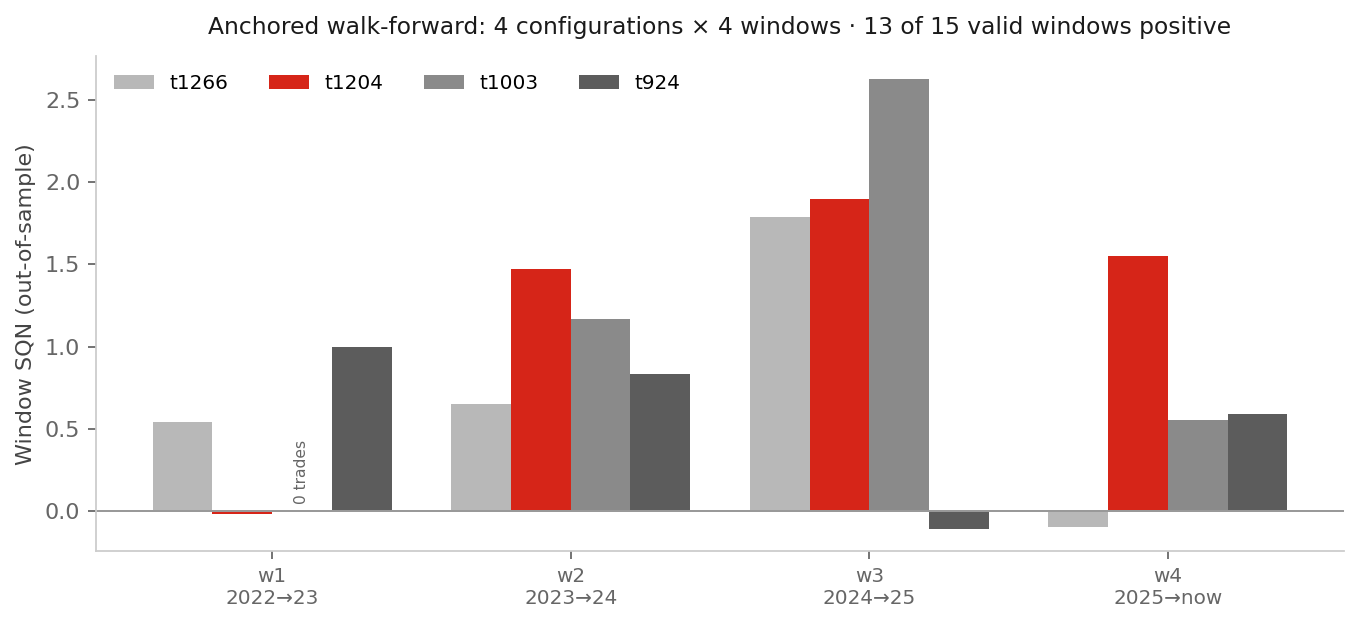
The contrast is the useful part. On the equity index, walk-forward was applied not to one trial but to a cluster of four neighbouring configurations sharing the same eight features with slightly different hyperparameters:
atr_ratio · dist_session_open · dist_swing_high_12 · dist_swing_high_24 · rs_plus · rsj · rv_ratio · upper_wick_norm
Two volatility-regime ratios, two realised-volatility decompositions, two distances to swing structure at different lookbacks, one session anchor and one candle-geometry measure. Exact windows, normalisations and thresholds are not published; the composition is, because it is the part that carries the lesson. All four configurations went through the process independently: 13 of the 15 valid windows came out positive, with pooled SQN between 1.04 and 1.80.
Four variants of the same region of parameter space surviving independently is a class of evidence a single trial can never provide. One winning configuration can be a lottery ticket. A neighbourhood that works is a property of the market — and that distinction is the entire subject of our article on overfitting in trading strategies.
How to run this on your own model
- Write the criteria first, in a file with a timestamp. If you decide the bar after seeing the windows, you have not run a test; you have run a negotiation.
- Set a minimum sample per window. Ours is 30 trades. Below that, a window is inconclusive, not negative.
- Give the most recent window a veto. Regimes end. A model that worked in 2022 and 2023 and is bleeding in 2026 is not a model with a good record; it is a model with an expiry date you have already passed.
- Purge every boundary. Wider than your maximum holding period.
- Freeze everything except the fit. Re-tuning inside walk-forward turns the test into another search and destroys the only virgin data you had.
- Replicate on a second timescale. A genuine effect usually leaves a trace at neighbouring horizons. Ours on Bitcoin did not.
FAQ
Is anchored or rolling walk-forward better for crypto?
Anchored is generally the closer match to how crypto models are actually operated, since production retrains typically use all available history rather than discarding it. Rolling designs are useful as a secondary check on regime dependence — if a model only works rolling, it is telling you its edge has a short shelf life.
How many windows are enough?
Enough that each window carries a usable sample. Four windows of 30+ trades beat twelve windows of eight trades, because eight-trade windows produce noise you will then be tempted to interpret.
Does a positive walk-forward mean the strategy is profitable?
No. It means the candidate has not been eliminated. Walk-forward is a filter, not a forecast — the next stages are Monte Carlo robustness, cost stress and a forward test on live data, described in our methodology overview.
This article describes methodology and aggregate results. Full configurations, trained models and exact execution parameters are not published. All figures include the execution venue’s real commissions. Nothing here is investment advice, and past or simulated performance is not a guarantee of future results.