
Our companion article explains why the LSTM branch did not survive. This one explains why XGBoost for trading remains the production backbone on BitcoinAI.Pro: not because gradient boosting is universally superior, but because it fits the size, structure and audit requirements of the BTCUSD D1 problem we measured.
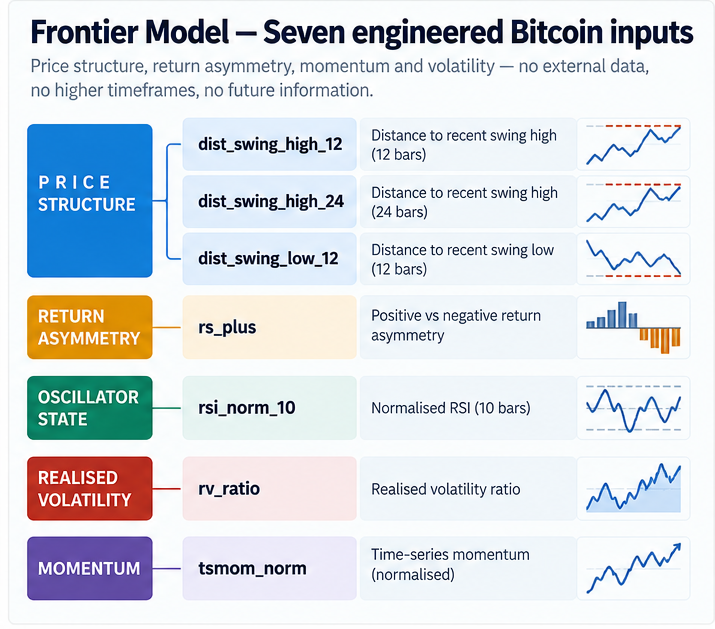
The current Frontier Model uses a frozen XGBoost signal binary, seven engineered Bitcoin inputs, no LSTM inference and no automatic production retraining.
Reason 1: the problem is small-data and tabular once the features are engineered
A daily Bitcoin history contains only a few thousand observations. That is a small dataset by deep-learning standards. Much of the economically relevant sequence context can be represented explicitly as features describing price structure, realised volatility, oscillator state and momentum.
Once those features exist, a regularised tree ensemble can spend its capacity on nonlinear interactions between them rather than learning basic summaries from raw sequences.
Reason 2: fixed-model inference is auditable
A frozen trained tree produces deterministic inference for the same input vector and model file. That makes live-vs-backtest reconciliation, signal logging and execution audits much easier.
This should not be confused with saying every XGBoost retrain is identical. Training can vary across seeds and stochastic settings, so retraining robustness has to be measured rather than assumed. That is one reason the current production binary is frozen.
Reason 3: sample efficiency
Tree ensembles are well suited to datasets where observations are limited but each row contains a compact set of engineered state variables. The current Frontier deliberately uses only seven inputs instead of expanding a large indicator library.
Reason 4: interpretability is useful as a diagnostic
Feature importance is not a causal explanation and should not be used mechanically for pruning. It is still a useful smoke alarm: calendar-like or sample-indexing variables can reveal themselves as suspiciously dominant before they damage an out-of-sample result.
The actual Frontier feature set: seven Bitcoin inputs
Older versions of this article described an eight-input equity-index model. That is not the current production system. The current BTCUSD Frontier signal uses these seven published inputs:
dist_swing_high_12dist_swing_high_24dist_swing_low_12rs_plusrsi_norm_10rv_ratiotsmom_norm
We intentionally stop there. The names are public; the complete feature formulas, target construction, target/prediction horizon, decision threshold, XGBoost hyperparameters and trained model are not.
What is deliberately not in the public recipe
- No exact prediction or label horizon.
- No target/barrier calibration.
- No decision threshold.
- No tree depth, learning rate, regularisation coefficients, sampling ratios or other XGBoost hyperparameters.
- No trained model weights / serialized production model.
- No full execution calibration.
The goal of the research articles is to make the methodology auditable without turning the production model into a copy-and-paste recipe.
Current Frontier research results
| Metric | In-sample | Strict model-weight OOS |
|---|---|---|
| Period | Jan 2018 – Jul 2022 | 30 Jul 2022 – Aug 2026 |
| Trades | 151 | 210 |
| SQN | 5.348 | 2.129 |
| Simple return | +733.7 pt | +253.9 pt |
| Win rate | 63.6% | 50.5% |
| Maximum drawdown | -31.04 pt | -25.34 pt |
| Profit / drawdown | 23.63 | 10.02 |
| Research leverage | 1:1 equivalent | 1:1 equivalent |
The separate continuous V111 replay contains 361 exact trades from January 2018 to August 2026 and ends at +992.65 simple percentage points, with a full-curve maximum drawdown of about -31.04 points. The research figures are 1:1 notional-equivalent and are not compounded account returns.
Why the current model is frozen
The project tested whether repeated rolling refits could improve adaptation. They did not reproduce the frozen binary strongly enough to justify replacement. The production signal model therefore remains frozen, and execution research is evaluated separately.
Practical lessons for XGBoost trading research
- Use chronology before model sophistication. A sophisticated learner on contaminated splits is still contaminated.
- Keep the feature set compact. More indicators mostly increase the search space in which overfitting can hide.
- Ablate rather than trust importance. The only reliable test of a feature is what happens when it is removed under the same validation rule.
- Do not select by TEST. Later blocks are evidence only if they were not used to choose the candidate.
- Treat retraining as an experiment. A refit schedule should earn its place rather than being assumed to be adaptive.
FAQ
Is XGBoost better than LightGBM or CatBoost for trading?
The library choice is usually smaller than the effect of labeling, chronology, leakage control, costs and validation discipline. The project uses XGBoost because it is the tree framework that survived its own research path, not because other boosting libraries are impossible.
Can XGBoost predict Bitcoin price direction?
A classifier can estimate conditional directional evidence under a chosen research target. That is not the same as forecasting an exact future Bitcoin price, and the public articles intentionally do not disclose the target horizon or calibration.
How many features does the current model use?
Seven — the inputs listed above. Older eight-input references on the site belong to a retired research branch and should not be read as the current Frontier.
Publication boundary. We publish aggregate research results, chronology, validation methodology and the names of the production inputs. We do not publish the target/prediction horizon, label/barrier calibration, decision threshold, exact XGBoost hyperparameters, trained model weights, or the full production execution recipe. Those details are deliberately withheld because they would make the production model substantially easier to reproduce.
See AI Trading Models for the current methodology and Why Our LSTM Bitcoin Model Failed for the model-class comparison.
Risk notice. Historical and simulated results are not guarantees of future performance. This article is research, not investment advice.