
Most explanations of walk-forward analysis for Bitcoin trading stop at a diagram: train here, test there, move the window and repeat. The useful part is harder: deciding the rules before seeing the result, preserving chronology, and accepting what happens when a model you already like fails to reproduce itself.
BitcoinAI.Pro has now run more than 1,000,000 machine-learning, execution and robustness trials. Only two BTCUSD D1 generations have reached operation: the legacy T1071 and the current Frontier Model. The most important walk-forward lesson from that lineage is not that frequent retraining automatically adapts better. It is that retraining itself is a hypothesis that has to survive testing.
What walk-forward analysis actually tests
A historical backtest asks how one frozen system would have behaved over data that is already known. A walk-forward study asks a different question: if the research process had stopped at successive dates and the model had been rebuilt using only the information available then, would the later blocks still show useful behaviour?
That makes each later block a simulated deployment. The method is valuable because it exposes two failure modes a single backtest cannot: regime dependence and retraining instability.
We use chronological blocks and purge-aware boundaries so information from a later block cannot leak into an earlier fit. The exact label horizon and production calibration are not published.
What changed after the original T1071 walk-forward study
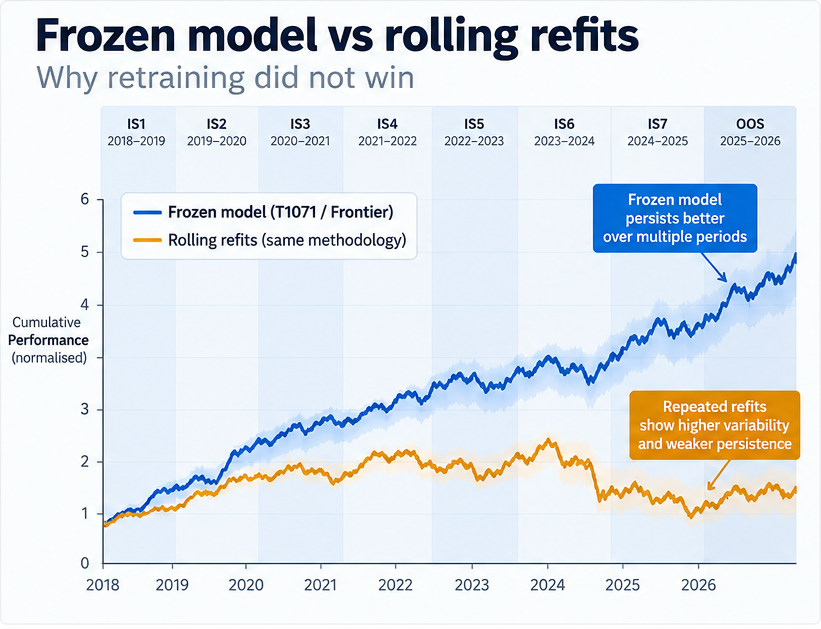
The older version of this article treated the T1071 walk-forward failure as the end of that Bitcoin branch and contrasted it with an equity-index candidate. That is no longer the right conclusion. Later reconstruction showed that the exact frozen T1071 signal binary contained a more persistent effect than the rolling refits were able to reproduce.
That distinction matters. A weak rolling refit does not prove the frozen model has no edge; it proves that the proposed retraining process did not preserve the same behaviour. The production response was therefore conservative: keep the signal model frozen and audit the execution layer separately rather than forcing periodic refits because retraining sounds more adaptive.
The current Frontier Model
The current Frontier is a BTCUSD D1 XGBoost system in the T1071 lineage. The production signal model is frozen, uses seven engineered Bitcoin inputs, contains no LSTM inference, and is not automatically retrained in production.
Published production inputs
dist_swing_high_12dist_swing_high_24dist_swing_low_12rs_plusrsi_norm_10rv_ratiotsmom_norm
Only the input names are published. Their complete definitions, target construction, prediction horizon, decision threshold and XGBoost parameterisation are not.
Current chronological evidence
The public research record separates the safe in-sample block from the later strict model-weight out-of-sample block. These are research statistics at 1:1 notional-equivalent exposure, expressed as simple percentage points rather than compounded account returns.
| Metric | In-sample | Strict model-weight OOS |
|---|---|---|
| Period | Jan 2018 – Jul 2022 | 30 Jul 2022 – Aug 2026 |
| Trades | 151 | 210 |
| SQN | 5.348 | 2.129 |
| Simple return | +733.7 pt | +253.9 pt |
| Win rate | 63.6% | 50.5% |
| Maximum drawdown | -31.04 pt | -25.34 pt |
| Profit / drawdown | 23.63 | 10.02 |
| Research leverage | 1:1 equivalent | 1:1 equivalent |
A separate uninterrupted V111 replay preserves state continuously across the research boundary. It contains 361 exact trades from January 2018 to August 2026 and finishes at +992.65 simple percentage points. That continuous result is not expected to equal the arithmetic sum of separately evaluated IS and OOS blocks, because the state at the boundary is handled differently.
What the walk-forward result means now
The current lesson is narrower and stronger than the old article’s verdict: do not assume retraining improves robustness. On this family, rolling refits were not strong enough to justify replacing the exact frozen signal model. The frozen model is therefore treated as a fixed research object, while later work tests execution and risk changes independently.
This is also why we no longer present an equity-index campaign as the successful counterexample. The operational lineage described on BitcoinAI.Pro is now explicitly Bitcoin-only: T1071 followed by the current Frontier Model.
How to use walk-forward analysis on your own model
- Write the decision rules first. If the pass bar changes after you see the windows, the test has become another optimisation.
- Protect chronology. Purge boundary observations when labels or trades can overlap later blocks.
- Separate refit risk from model risk. A model can be stable while the retraining recipe is unstable, and vice versa.
- Compare complete trade streams. Headline SQN can hide changes in entry order, overlap and opportunity availability.
- Do not force retraining. If a frozen binary is more stable than repeated refits, ‘adaptive’ is not automatically better.
- Reserve future forward data. Once a block has been inspected repeatedly, it is research history, not virgin evidence.
FAQ
Is anchored or rolling walk-forward better for crypto?
Neither is universally better. Anchored designs test an expanding-history refit; rolling designs emphasise recent regimes. The correct choice depends on the production process you are actually testing. For the current Frontier, the more important finding was that repeated refits did not justify replacing the frozen model.
Does a positive walk-forward mean the strategy is profitable?
No. It means a specific retraining or deployment procedure survived one validation layer. It does not remove market risk, execution risk or future regime change.
Why keep a frozen model if markets change?
Because changing a model is also a source of risk. A refit should replace a frozen model only when the refit process itself shows stronger and sufficiently stable evidence. In this case, it did not.
Publication boundary. We publish aggregate research results, chronology, validation methodology and the names of the production inputs. We do not publish the target/prediction horizon, label/barrier calibration, decision threshold, exact XGBoost hyperparameters, trained model weights, or the full production execution recipe. Those details are deliberately withheld because they would make the production model substantially easier to reproduce.
See the current methodology and statistics on AI Trading Models, the public research record on the BitcoinAI.Pro home page, and the related article on overfitting in trading strategies.
Risk notice. Historical and simulated results are not guarantees of future performance. This article describes research methodology and is not investment advice.